




"Fact" daily writes:
The history of revolutions and, why not, also the present one, painfully testify to the tragic pattern when the forces that came to power with liberating ideas, promises of justice and welfare not only do not fulfill their rhetorical obligations, but also depress their peoples in deeper crises, blood, suffering and territorial losses.
This pattern not only repeats itself in different eras, different cultures and different geographical areas, but also reveals the deeply contradictory nature of revolutionary changes, when noble ideas turn into violence, when promises of freedom are replaced by new dictatorships, when demands for justice lead to mass conspiracies and destructions.
The French Revolution, which began in 1789 with the slogan "Liberty, Equality, Fraternity" and promised an end to royal tyranny, aristocratic privilege, and social injustice, quickly turned into a bloody terror.
The revolution, which was supposed to bring enlightenment, brought civil war, the massacres of the Vendée, where hundreds of thousands of people were massacred, and finally led to the Napoleonic dictatorship, which plunged Europe into twenty years of continuous wars, causing millions of casualties.
The revolution, which was supposed to eliminate violence, created mechanisms of bloodier and more systematic violence. The event that was supposed to bring equality created a new social hierarchy dominated by the revolutionary elite.
The Russian Revolution of 1917 became another tragic example of how noble ideas can be embodied in bloodshed. The Bolsheviks, led by Vladimir Lenin, promised land to the peasants, factories to the workers, peace to the war-weary people, bread and freedom to all.
They proclaimed a new world order, where there will be no exploitation, where everyone will be equal, where the power will belong to the workers and peasants. The reality, however, was terrible.
Lenin came to power in a violent coup, overthrowing the legitimate government, and one of his first steps was to brutally murder Tsar Nicholas and his entire family, including his children. This atrocity marked the bloody path that the new government would follow.
Bol Sheviks established the "Red Terror", during which hundreds of thousands of people were exterminated: former nobles, clergy, ordinary citizens who were considered "class enemies".
The civil war, which lasted from 1918 to 1922, turned into a disaster for the entire country with millions of victims, famine, epidemics, and the complete destruction of the economy. Lenin's successor, Joseph Stalin, instituted the bloodiest repressive system ever known to mankind.
The revolution, which promised a workers' paradise, created a tyrannical regime where the value of human life was reduced to zero, where ah became the main tool of government, where free speech, free thought became impossible. The communist revolution in China led by Mao Zedong in 1949 also promised freedom, justice and prosperity.
Mao proclaimed that he was creating a new China where there would be no exploitation of peasants, where the land would belong to those who worked it, where foreign dependence and internal corruption would end.
In fact, Mao implemented policies that led to one of the deadliest famines in human history. Between 1959 and 1961 (some say until 1962), China experienced one of the largest famines in human history, known as the Great Chinese Famine, which killed millions.
And the "Cultural Revolution", which Mao started in 1966 to maintain his power, turned into a war against intellectuals, traditional culture, and education. Millions of people were persecuted, tortured, killed or forced to commit suicide. The country was plunged into chaos, violence and paranoia for ten years. In the modern era, this pattern continued its tragic logic.
The Arab Spring that began in 2010-2011 brought a wave of hope throughout the Middle East and North Africa. In Tunisia, Egypt, Libya, Syria, Yemen and other countries, the people took to the streets demanding freedom, democracy, social justice, economic opportunities. The young people who used social media to coordinate the movement dreamed of a new world where they could express themselves freely, choose their own leaders, get education and work.
However, in almost all countries, these uprisings had disastrous consequences. Then the Maidan revolution in Ukraine in 2013-2014 became a new tragic example. Ukrainian demonstrators, mainly young people, protested against the authorities of Viktor Yanukovych, demanding the signing of an association agreement with the European Union, the fight against corruption, legal reforms, and a better life.
The revolution won, Yanukovych left, new forces came to power, promising to bring Ukraine into the European family. However, the consequences were disastrous. The revolution, which was supposed to bring a European future, brought war and territorial losses.
The Rose Revolution in Georgia in 2003 overthrew the regime of Eduard Shevardnadze and brought to power Mikheil Saakashvili, a young, pro-Western politician who promised reforms, the fight against corruption, and integration into the Western system.
Although Saakashvili implemented some reforms in the areas of police, tax service, civil service, his aggressive foreign policy led to war with Russia in 2008, as a result of which Georgia lost Abkhazia and South Ossetia.
The revolution, which was supposed to bring empowerment, brought territorial losses and a long-term security crisis.
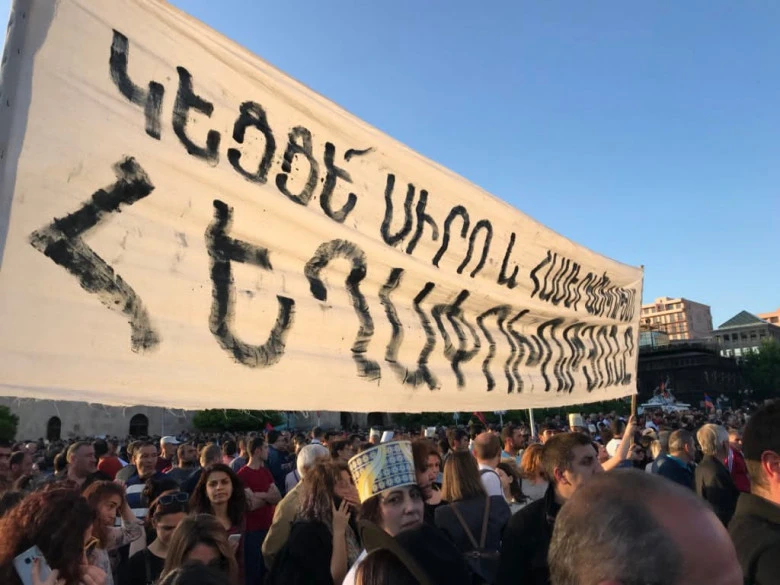
In Armenia, the so-called "velvet revolution" of 2018 brought to power Nikol Pashinyan, a former journalist and opposition figure, who promised to end corruption, establish real democracy, improve the economy, and fight oligarchs. The street demonstrations, characterized as peaceful and non-violent, created an atmosphere where there was hope for change. But even after years, those positive changes have not become a reality. On the contrary, the consequences of Pashinyan's tenure were disastrous.
In 2020, as a result of the Artsakh war, Armenia lost significant areas of Artsakh, thousands of soldiers were killed, and tens of thousands of people became refugees. And in 2023, Azerbaijan occupied Artsakh, and the entire Armenian population of historical Artsakh, more than 100 thousand people, was forced to leave its historical homeland. This was a human and territorial disaster, which many analysts associate with Pashinyan's rise to power and his security, diplomatic, and military policies and omissions.
This is to say the least. The revolution, which was supposed to bring freedom and prosperity, brought territorial loss, national tragedy and deep social division. All these examples reveal the tragic patterns of this type of revolutions. The first is the abysmal break between the cause and effect relationship, between the revolutionary ideology and reality.
The revolutionaries present themselves as saviors who will usher in a new era, but when they come to power, they face a complex reality that does not correspond to the theories they present. The need to maintain power, internal and external threats, economic difficulties, social conflicts force them to abandon their ideals and resort to violence, pressure, and manipulation.
The second pattern is the inevitability of the repressive system. Revolutions have an internal logic that leads to authoritarianism. When revolutionaries violently overthrow the old order, they set a precedent that power can be seized by force. This means that the same power can be used against them.
Therefore, they create mechanisms of repression - secret police, censorship, political persecution, mass surveillance - in order to maintain their power. These mechanisms often exceed the former regime's means of repression.
The third regularity is the formation of the revolutionary elite. Revolutions promise equality, but create a new elite that enjoys privileges. Party leaders, revolutionary heroes, new bureaucrats become a new aristocracy with their own interests, which contradict the interests of the people.
They use revolutionary rhetoric to justify their privileges, but in fact reproduce the same inequality they fought against. The fourth pattern is the factor of external interference.
Revolutions, which are carried out by external intervention, often weaken states, create internal divisions, which in turn gives the same external forces the opportunity to implement their deep plans.
Great powers use the revolutionary chaos to advance their interests, to support one side against another, to seize territories, to create dependent regimes.
This leads to territorial losses, long-term conflicts, weakening of national sovereignty. The other pattern concerns social division. Revolutions divide society into "ours" and "foreigners", "revolutionaries" and "counter-revolutionaries", "blacks" and "whites".
This creates an atmosphere where it is possible to justify any violence against "enemies". This division has continued for decades and is hampering efforts at national reunification. These patterns do not mean that reforms are impossible or that unjust regimes should be tolerated.
But they show that revolutions that bring opportunists to power who promise quick and radical changes rarely bring positive results.
ARTHUR KARAPETIAN
Details in today's issue of "Past" daily