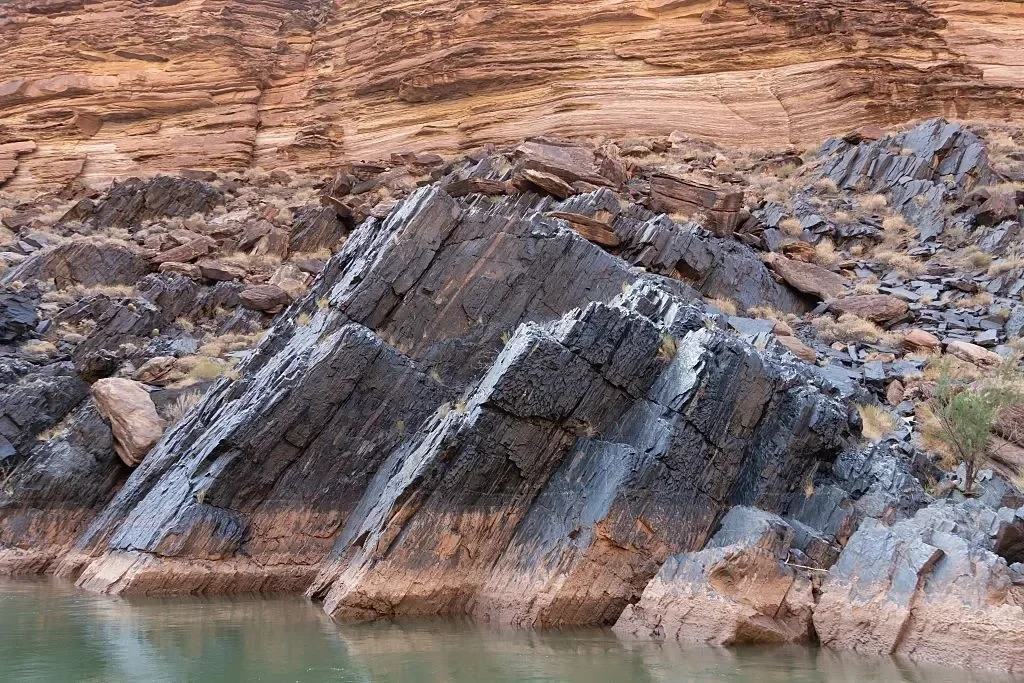
The geological layers of the Grand Canyon in the United States lack evidence of about 1.2 billion years of Earth's history. A new study has shown that the cause of this gap could be the movement of Earth's mantle, which uplifted some parts of the continents—intensifying erosion—and later led to their subsidence and accumulation of new sedimentary rocks, Live Science reports.
About 1.7-billion-year-old ancient metamorphic and magmatic rocks in the canyon walls directly touch younger sedimentary rocks that formed about 500 million years ago. Between them is a huge interval of geological history missing, known as the Great Unconformity.
This period is especially important for understanding the history of life on Earth: it preceded the Cambrian explosion and partly overlapped with it—a phase when the diversity of living organisms sharply increased. Such gaps in geological layers have been found not only in North America but also in the Baltic region of Europe and northern China. Scientists have long debated the reasons for their formation.
In a study published in the journal Nature, scientists proposed an explanation based on modeling the movement of Earth's mantle. The mantle is the layer beneath the Earth's crust where material slowly moves under the influence of heat.
The model showed that mantle circulation could have caused the uplift of the three regions during the formation of the Great Unconformity. This contributed to erosion: sedimentary materials were removed from the continents and transported to the oceans. Later, over the last 540 million years, these areas began to subside. Spaces emerged where sediments could accumulate, forming new rock layers. These findings are consistent with geological observations made in North America, the Baltic region, and northern China.
"We studied where the mantle's influence might have led to the formation of the Great Unconformity. It turned out that all three regions are exactly the places where this geological phenomenon is particularly pronounced," said Nicholas Flament, co-author of the study and geologist at the University of Wollongong in Australia.
Previously, some scientists linked the Great Unconformity's formation to global glaciation periods when ice might have contributed to extensive rock weathering and the removal of sediments from continents. According to Flament, glaciation likely did play an important role. However, the new study points to a deeper cause: without the mantle movement-induced uplift of continents, ice sheets and other erosion factors could not have transported sediments downhill so effectively.
The Earth's crust is continuously renewed due to plate tectonics. Oceanic plates subduct beneath other plates and descend into the mantle; this process is called subduction. Various chemical elements enter the planet's depths with them and can later return to the atmosphere during volcanic eruptions.
Moreover, the composition of material entering the mantle changes over time. For example, the ancient Paleotethys Ocean, which existed near the shores of the supercontinent Pangaea and closed about 200 million years ago, contained carbon-rich sediments washed from continents. When the ocean floor subducted into the mantle, some of that carbon ended up deep within the Earth.
Today, a significant portion of subduction zones is concentrated around the Pacific Ocean, whose ocean floor is far from continents and contains relatively little carbon-rich sediment. Therefore, the chemical composition of materials entering the mantle now differs from that characteristic of other geological periods.
According to geologist Shanan Peters from the University of Wisconsin–Madison, the absence of certain rocks should not be considered merely a loss of information. This gap in the geological record itself allows us to form an idea about the processes that occurred on Earth and their possible impacts on the development of the atmosphere and life.
During the period when the Great Unconformity formed, crystalline rocks exposed at the surface could have more actively released potassium, iron, manganese, and carbon into the oceans. This could have influenced the development of marine organisms, including contributing to the emergence of the ability to form mineral structures such as shells. The changes might also have affected the atmosphere's composition and the increase of oxygen levels.