




"Zhoghovurd" daily writes:
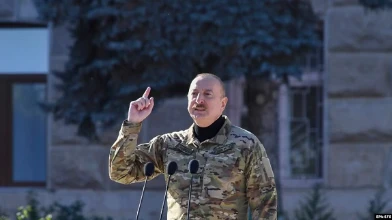
"Azerbaijan intends to actively exploit almost all the mines of Artsakh. This is evidenced by the latest decree signed by the President of Azerbaijan, Ilham Aliyev, on measures aimed at the development of the mining and metallurgical industry in Azerbaijan.
The document emphasizes that the development of these sectors is of strategic importance for Azerbaijan, and the exploitation of the mines of the occupied Artsakh, which were either not exploited or not fully exploited, is also specially emphasized.
Candidate of geographical sciences, associate professor Yuri Arakelyan presented in an exclusive conversation with "Zhoghovurd" daily what mineral resources Artsakh has, what has already been exploited and what Azerbaijan can focus on. According to him, the history of Artsakh is extremely diverse. "Due to the diversity of the geological structure of the territory of Artsakh, minerals are diverse.
A rich variety of metallic and non-metallic minerals are found. There are no industrial fuel deposits in the territory of Artsakh. There are no oil and gas reserves, which could be an alternative type of coal.
In the territory of the Republic of Artsakh, coal layers are found in some sections of Jurassic and Cretaceous sediments: in the Maghavuz mine, in the Nareshtar mine, and in the Kolatak mine. Despite the smallness of the territory, Artsakh is also characterized by metal minerals.
As you know, metal smelting has been known in Artsakh for a long time. This is evidenced by the ancient foundries of Khtsaberd and Mehmana." According to the presentation of Yuri Arakelyan, the explored and calculated reserves in the territory of Artsakh are Drombon (gold-copper ore), Mehmana (multi-metallic), Tapasar (chromite) and Zuar (mercury), Tondrak River (gold). Mineral fields with signs of direct and secondary mineralization: Chankatagh-Vardadzor /Kasheni/, Elbeksar /copper-multimetallic/, Mets Bnartap /copper-molybdenum/, Levy /mercury/ mines, which needed exploration.
1: Paused He also mentions which of them have already been exploited.
"Out of the above, the mines of Drombon /depleted/, Tondraget, Chankatagh-Vardadzor /Kashen/ have been exploited." According to the expert, Artsakh is also rich in non-metallic minerals: limestone, marble, granite, gabbro, basalt, andesite, tuff, pumice, perlite, sand, clay and other resources.
Turning to the Karvachar section separately, Yuri Arakelyan said in a conversation with "Zhoghovurd" daily. "In the upper part of Karvachar, more specifically, Dadivank, there are red and precious stones, which are mercury deposits. This has not been mined.
First of all, it is a costly and laborious process, and secondly, the supplies were not that much. In the rocks from the eruptions, many small pieces of diamonds and ghosts were also found. It was on the border of Armenia and Artsakh, which stretches from the Sevan mountain range to below Kirsi, more than 200 km long.
It can be extracted in a cold state, which depends on investments. Today, Azerbaijan's attention is mainly on chrome and gold, which I cannot say whether they are mining or not." According to the geologist, gold mining is usually effective, but everything depends on expediency and financial calculation.
According to Yuri Arakelyan, when mining gold, one should always understand whether the miner will profit or spend more resources. In this sense, according to his observation, it can be assumed that Azerbaijan, taking into account its politics and financial possibilities, will try to use the resources of Artsakh.
Thus, the document signed by Aliyev and the professional evaluations presented in the exclusive interview of "Zhoghovurd" daily show that Azerbaijan is trying to include the occupied Artsakh subsoil in rapid economic exploitation, focusing especially on the most profitable mines.