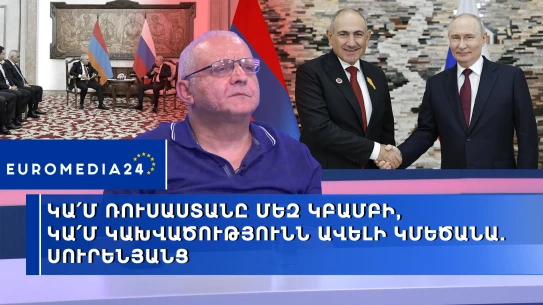





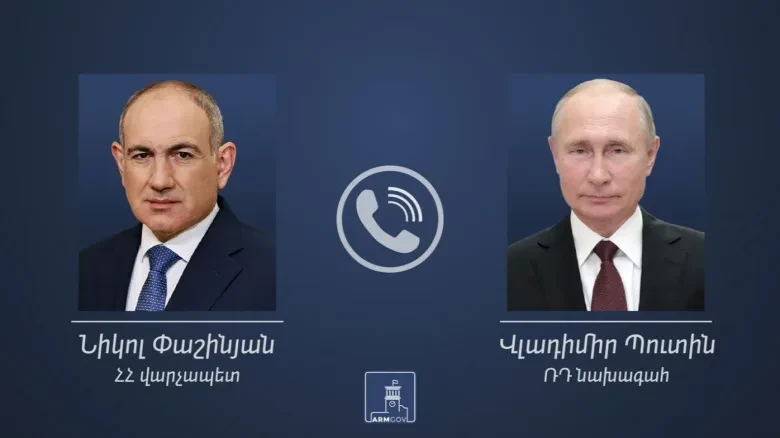
Nikol Pashinyan's July 27 telephone conversation with Russian President Vladimir Putin was the first since the June parliamentary elections. According to political scientist Suren Surenyants, this telephone conversation was politically significant, as it took place against the background of the accumulated tension in Armenian-Russian relations and the economic difficulties caused by restrictions on Armenian exports to the Russian market. "It is noteworthy that the conversation with Putin was preceded by Pashinyan's phone conversations with the Chancellor of Germany With Friedrich Merz (July 22) and French President Emmanuel Macron (July 25). The contacts with the European partners, apparently, did not give the result that could alleviate the restrictions of the Russian market.
In those circumstances, turning to Moscow has become not so much a political choice as an objective necessity.
According to the official statement from Yerevan, Pashinyan raised the issue of restrictions on the export of goods of Armenian origin, emphasizing that they contradict both the Armenian-Russian legal framework and the principles of the Eurasian Economic Union, and asked for measures to be taken to resolve the issue. The Kremlin's official statement, however, reveals a completely different priority.
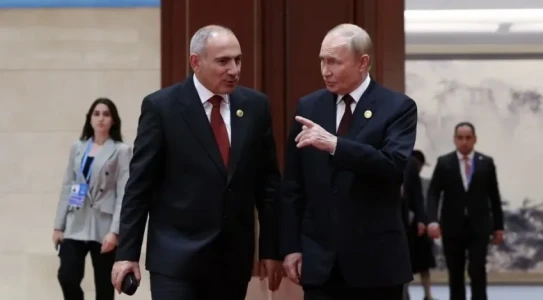
The Russian side has again brought the issue of European integration of Armenia to the agenda. Putin reaffirmed the logic of the joint statement adopted by the leaders of the four EAEU member states (Belarus, Kazakhstan, Kyrgyzstan, Russia) in Astana on May 29 and emphasized the need to hold a national referendum in Armenia as soon as possible to clarify which strategic direction the country chooses: the European Union or continuation in the EAEU. In response, Pashinyan actually admitted that the EU membership process is not yet at a practical stage, noting that the referendum the holding will be possible only when Armenia officially applies to the European Union. However, even this cautious position has not produced any visible results. After the phone conversation, no announcement was made about the lifting or relaxation of export restrictions. Moreover, the Kremlin's message did not even mention economic issues, thereby clearly showing Moscow's priority. Another circumstance is also noteworthy. This is another case when Putin does not congratulate Pashinyan on his victory in the parliamentary elections. In the practice of interstate relations, such silence is rarely accidental and, as a rule, contains a political message. The content of the telephone conversation was clearly a continuation of the political logic of the Pashinyan-Putin meeting held on April 1 and the Astana statement.
Moscow is no longer going to tolerate Yerevan's "sitting on two chairs" policy. Moreover, the Astana document stipulates that by December 2026, the EAEU intergovernmental council must submit a report on the possible consequences of suspending the application of the EAEU treaty to Armenia. This is no longer a warning, but a process with specific deadlines. Thus, the Pashinyan-Putin telephone conversation did not become the beginning of overcoming the crisis in Armenian-Russian relations.
On the contrary, it reaffirmed that strategic differences between the parties continue to deepen, and economic problems are already one of the most visible manifestations of that crisis. Moscow is clearly not ready to be guided by Yerevan's economic difficulties or political explanations. Russia continues to expect from Armenia not assurances, but a clear and final strategic choice. Москва слезам не верит. This phrase best describes the political content of yesterday's phone conversation," the political scientist notes.