





"Fact" daily writes:
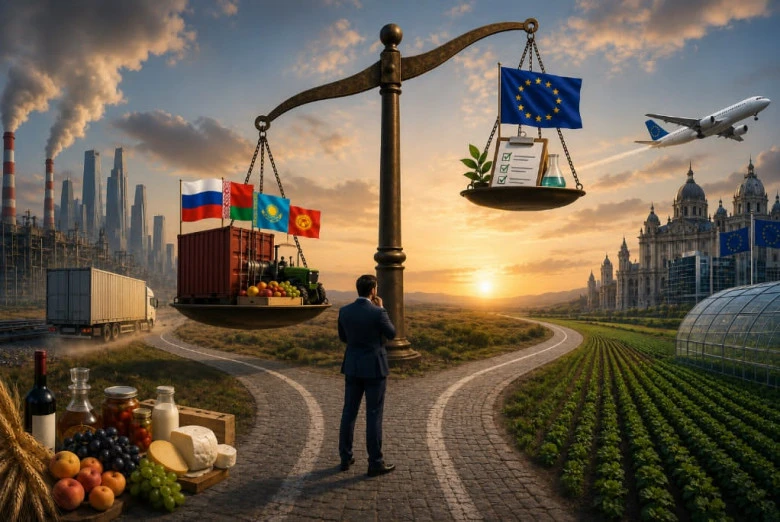
While the Armenian authorities are announcing the need for integration in the European direction, the limited effectiveness of the EAEU or even the possibility of self-dissolution of that structure, warnings are continuously being sounded from Moscow, and recently certain economic restrictions related to the export of Armenian products, especially agricultural products, have already become noticeable. It should be noted that, regardless of political evaluations, Armenia received tangible economic benefits after joining the EAEU. The figures prove that Armenia's export volumes have grown significantly in the last decade, and one of the main drivers of this growth has been the EAEU single market.
In particular, the Russian market, with its volumes, consumer demand, linguistic and cultural proximity and relative logistical accessibility, has become a key direction for Armenian producers. Moreover, it is not only about large enterprises.
Thousands of small and medium entrepreneurs of Armenia connect their existence with the Russian market. From farmers producing agricultural products to manufacturers of canned goods, alcoholic beverages, dairy products, confectionery, light industry, all are significantly dependent on access to the EAEU market.
If Armenia leaves the EAEU, the first and most direct consequence may be the loss of the unified customs regime. Today, Armenian products enter the EAEU territory without customs duties, with simplified administration and within the framework of unified technical regulations.
In case of leaving the Union, these privileges will disappear. Armenian producers will have to face additional customs fees, stricter sanitary and phytosanitary requirements, new certification procedures and administrative complications. This will increase the cost of Armenian products and weaken its competitiveness.
One of the most vulnerable sectors is agriculture. A significant part of Armenian agricultural products is consumed in the Russian market. Armenian apricots, peaches, grapes, tomatoes, preserves, juices, wine, brandy and other products have formed their consumer niche in Russia over many years.
However, it is necessary to understand that the Armenian product is competitive in the Russian market not only due to its quality, but also due to the existing preferential conditions. If these conditions disappear, Armenian producers will have to compete with producers from Turkey, Iran, Morocco, Egypt, Uzbekistan, Azerbaijan, Serbia and other countries without any protective mechanism.
Armenia's small-volume and relatively high-cost agriculture may face serious problems under such competition. It is often said that after leaving the EAEU, Armenia can quickly reorient itself towards European or other markets.
However, the economic reality is much more complicated. Export markets are not shaped by political statements. Creating markets is a long-term process that takes years, sometimes decades.
It is necessary to create logistics infrastructures, ensure quality compliance, establish business connections, implement marketing strategies, study consumer preferences and overcome many technical obstacles.
For example, the European market is one of the most competitive markets in the world. It has extremely strict standards related to food safety, environmental norms, packaging, traceability and quality control.
A significant part of Armenia's agriculture and processing sector is still not fully prepared for these requirements. Even in cases where Armenian products are able to enter the European market, export volumes are often limited and competition is extremely intense. In Europe, Armenian products have to compete not only with local producers, but also with almost all major exporters in the world.
In addition to export problems, leaving the EAEU may also negatively affect the investment environment. In recent years, many companies have invested in Armenia, taking into account the fact that Armenia is a member of the EAEU and provides an opportunity to access a market with about 180 million consumers without customs barriers. If that advantage disappears, Armenia's investment attractiveness may decrease. Especially those companies that consider Armenia as a platform to enter the EAEU market may reconsider their plans. The issue of free movement of labor cannot be ignored either.
Within the EAEU, Armenian citizens benefit from simplified conditions for working in Russia, Belarus, Kazakhstan and Kyrgyzstan. They are freed from a number of bureaucratic procedures, have a certain system of social guarantees and can be more easily integrated into the labor market. If Armenia leaves (or is removed from) the EAEU, it is possible that Armenian migrants working there will face additional restrictions.
Considering that the incomes of many Armenian families continue to depend on remittances received as a result of foreign work, such a development may have serious social consequences. Another important circumstance is the energy sector. Armenia is significantly dependent on imported energy sources, and the price of Russian gas has been one of the key components of Armenian-Russian economic relations for many years.
Although there is no guarantee that EAEU membership in itself ensures preferential prices, nevertheless, the general logic of economic and political relations shows that leaving the integration structures can also affect the conditions of energy cooperation. Even a modest increase in energy prices can have ripple effects throughout the economy, raising production costs, inflationary pressures, and social burdens.
At the same time, it is necessary to emphasize that EAEU membership and economic diversification are not contradictory processes. On the contrary, many countries successfully combine different economic directions. The most effective strategy for Armenia could not be the loss of existing markets, but the combination of their preservation and the development of new directions. Economic diversification does not imply giving up already existing markets.
It implies the addition of new markets, the distribution of risks and the gradual reduction of dependencies. Considering its geographical location, Armenia could and still can become a unique economic bridge between different integration areas. On the one hand, being a member of EAEU, and on the other hand, having a Comprehensive and Extended Partnership Agreement with the European Union, as well as developing relations with the Middle East, Iran, India and other countries, Armenia could form a multi-vector economic model. In this case, the country could not face the choice with "either-or" logic, but use all possible directions to get the maximum economic benefit.
It is noteworthy that international experience shows that countries with small economies usually strive to be involved in as many economic platforms as possible, rather than limiting their opportunities. For small and open economies, the diversity of markets is vital. For a country like Armenia, which has a limited domestic market, a complex geopolitical environment, and transportation constraints, any loss of access to foreign markets could cause significant economic shocks.
In this context, it would be more appropriate not to make political statements about leaving the EAEU or the self-dissolution of the structure, the alleged "humors" of the order "it won't happen, it won't happen", but the policy based on pragmatic economic calculations. The interests of Armenia's economy require maximum use of existing integration opportunities, while consistently working on the formation of new markets, new partners and new investment directions.
Otherwise, if the EAEU market is closed or significantly restricted, Armenia's economy could face the risks of reduced exports, reduced investment, job losses, slower economic growth, and increased social tensions, which would be especially dangerous in the current volatile regional environment.
ARSEN SAHAKYAN
Details in today's issue of "Past" daily