




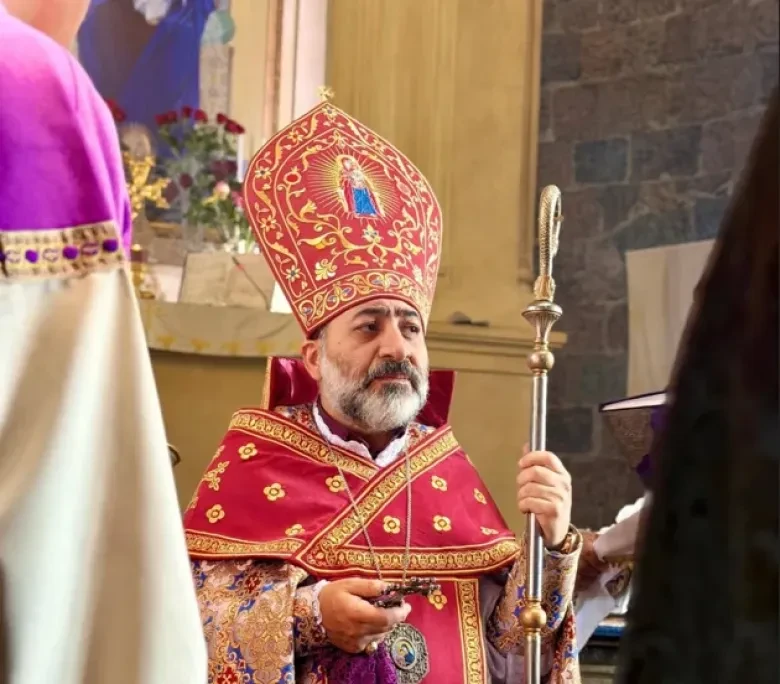
Bishop Isahak Poghosyan, leader of Gegharkunyats Diocese, said, "The Church has no right to engage in politics." published with the caption "a dangerous fallacy".
"In our time, one can often hear a judgment that has almost turned into a self-sufficient slogan. "The church has no right to engage in politics." This phrase is usually presented as a self-requirement of the modern secular state, with which disagreement seems already to be a sign of political or religious extremism. From the theological point of view, the question should be formulated differently. whether the church can give up its witness on the fate of society and whether it can remain silent where truth, justice, human dignity and the ontological foundations of the people are threatened. Essentially, the problem was never whether the church should rule the state, but whether the state can survive without the moral and spiritual foundations that the church constantly reminds us of.
"Caesar, Caesar". demarcation, not division
Christ's words, "Render to Caesar what is Caesar's, and to God what is God's," are often interpreted as a formula for the complete separation of religion and politics. However, such a reading is narrow and superficial. In the Roman world, the emperor was not only a political leader, but often claimed divine status. First of all, the word of Christ limited the ambitions of the state. It said that there was a sphere over which Caesar had no authority. A person's conscience, truth, a person bearing the image of God do not belong to the state. Thus, Christianity did not dissolve politics, but freed man from the deification of politics. The Church was born as a reminder that no earthly authority is absolute. Its existence is already a noticeable limit for every political system.
The prophetic mission of the Church
In the Holy Scriptures, God's people are never separated from history. Prophets are constantly talking about kings, rulers, judges and social injustices. Amos condemns social oppression, Isaiah exposes the corruption of the government, Jeremiah rebukes national self-deception. Prophet Nathan condemns King David. None of them aspires to political power, but none of them remains silent in front of the government. The prophet's mission is not to take power, but to judge power in the light of truth. In this sense, the church is a prophetic community. His mission does not end in front of the tabernacle. He is called to testify about God's truth in history as well.
The Church's Temptation of Silence
History shows that one of the greatest dangers for the church is not political activism, but moral silence. When the state absolutizes itself, when the nation turns into an idol, when ideology replaces the truth, the church's silence is equivalent to complicity. The tragedies of the 20th century are evidence of this. Totalitarian systems were not afraid of "silent churches". They were afraid of those "churchmen" who reminded that man was created in the image of God and cannot become a material for political projects. When the church is silent for the sake of peace, it ceases to be salt and light. He can keep his structures but lose his soul.
Politics and moral order
Politics is meant to organize public life, but it does not independently create the standards of good and evil. The law can define what is permissible, but it cannot answer for itself what is just. Democracy can express the will of the majority, but the majority does not always identify with the truth. That is why the society needs such institutions that remind of the moral order independently of the government. The church is one of them, perhaps the oldest and most responsible. Its purpose is not to make political decisions, but to remind that there is a truth that does not arise through voting.
The Armenian experience
In the history of the Armenian people, the church was never just a religious institution. For centuries, it has been the guardian of national memory, the center of education, the creator of culture and, in the absence of statehood, the pillar of collective identity. This historical experience is not an accident. It stems from the nature of the church. The Christian community does not exist outside of history, but within history. He shares the fate of his people and cannot be indifferent to their future. Therefore, demanding silence from the church during national, cultural or state crises means demanding that it renounce its historical memory and its own identity.
And so
The church is not called to rule the state. He is not called to become a party, an election machine or a competitor of secular power. However, the church is not called to be silent either. Its mission is to remind that the state is not the final reality, that politics cannot replace the truth, and that human dignity is above every ideology and power. When the church tries to become a state, it compromises its mission. But when he refuses to speak for the truth, he betrays his mission. Therefore, the question is not whether the church should talk about politics. The question is whether he will dare to remain the public conscience in a world that often forgets that Caesar himself is subject to a higher judgment.
p.c. If it is about participating in the party struggle for state power, elections or supporting candidates, in many countries it is accepted that the church should refrain from direct political activity, maintaining the principle of separation of the state and the church. If it is about expressing a position on issues of public, moral or national importance, then religious organizations, like other public institutions, usually have the right to freedom of speech and can express themselves on public issues. The principle of separation of church and state means that the church does not exercise state power, the state does not manage the religious life of the church, state decisions are not adopted by church orders. Throughout history, the church and politics have almost always been interconnected.
For example, S. Although Mesrop Mashtots was a clergyman, he was involved in the creation of Armenian writings, Martin Luther, although he was a clergyman, is mostly known as a civil rights leader. In the same way, Movses Khorenatsi, St. Nerses Shnorhali, Mkrtich A Khrimyan, influential political figure: Archbishop Thomas Becket, Cardinal Rechelier, Cardinal Mazarin, Girolamo Savonarola, Hovhannes-Paul II. Even in recent times, many churches have played a role in social movements, for example, in the struggle for civil rights, for example, Grigor Tatevatsi, Desmond Tutu, Pope Gregory 7, Oscar Romero. Therefore, the complete separation of church and politics is a relatively new phenomenon. Thus, the statement "The Church has no right to engage in politics" is too absolute. A more balanced position might be the following. The church has the right to express itself on public and moral issues, but it should not turn into a tool of party or government struggle."