




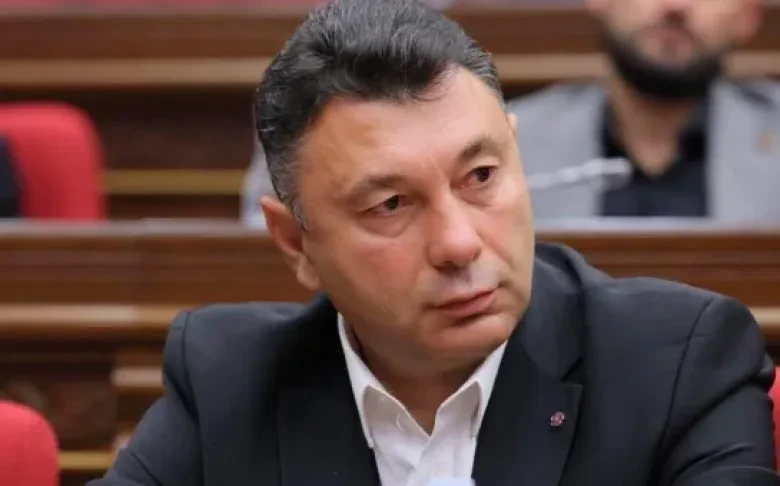
RPA GM member Eduard Sharmazanov writes.
"The unfair, forced and one-sided process full of concessions cannot lead to guaranteed and long-term real peace. Let me remind you that back in July 2024, the speech of the US representative James O'Brien was published, according to which the US strives to establish transport communication with the countries of Central Asia through Armenia and Azerbaijan, bypassing Russia and China. Moreover, the US official said this in the context of taking economic countermeasures against Russia, which would lead to Russia's strategic defeat. It's no secret that from the beginning the West considered Georgia an important platform for the fight against the Russian Federation, but after receiving the refusal of the Georgians, it turned its attention to Armenia.
A few years ago, the Georgian authorities even announced the inadmissibility of the West interfering in Georgia's internal affairs. According to press reports, the honorary president of the ruling "Georgian Dream" Bidzina Ivanishvili even refused to meet with the American officials who arrived in Tbilisi. It can be assumed that such behavior of the Georgian government "forced" the West to turn its attention to Armenia. In an open text, O'Brien spoke about the need for transport communication between Azerbaijan and Armenia, which actually contradicted the interests of Iran, the Russian Federation, and why not China. It is obvious that the implementation of the transport project connecting the countries of Central Asia with Azerbaijan, Armenia and Turkey was improbable as long as there was the problem of Artsakh. And after Artsakh was handed over to Azerbaijan, the implementation of such a project could be real as a result of pressure from Turkey and Azerbaijan.
The previous authorities of RA led by Serzh Sargsyan, whose political credo was the thesis that "Artsakh cannot be a part of Azerbaijan" was the obstacle to that "program". Therefore, the West, and I do not exclude Turkey, first implemented a "color revolution" in Armenia in 2018, and in the following years, with the tacit consent of the RA rulers, they implemented the surrender and depopulation operation of Artsakh. In such a situation, Iran began to publicly express its concerns. A few years ago, during a meeting with Nikol Pashinyan, Iran's spiritual leader Ali Khamenei stated that "foreign states should not interfere in the relations of neighbors and that the Zangezur Corridor is not in the interests of Armenia." It is no secret that Iran has expressed its displeasure several times against the deployment of EU observers in RA and the strengthening of the West's position in the region. Iran has categorically opposed that plan, understanding very well that it will serve the interests of Turkey and the West.
It is for this reason that the Strategic Research Council of Iran expressed an opinion in 2024, according to which the last Karabakh war was necessary for the West to create a "Turanic Corridor". It is no coincidence that in Iran that corridor is not called "Khalaghoptian Crossroads", but "Turanian Corridor". RPA has always expressed its concern about such a program and even adopted a special GM statement on August 11, 2025. Let me remind you of the key points of the announcement of the General Assembly of the Republican Party of August 11, 2025. "Highly appreciating the peace-loving efforts of US President Donald Trump, it should be noted that by signing this agreement, the adventurous rulers of Armenia are putting Armenia's sovereignty to a dangerous test, as well as sacrificing the rights of the Artsakh people, legitimizing the fact of ethnic cleansing and depatriation carried out by the Baku regime in Artsakh. In particular: The memorandum ignored the mandatory demand for the withdrawal of Azerbaijani forces from the occupied territories of the Republic of Armenia. The memorandum does not establish any obligation regarding the release of Armenian prisoners and military-political leaders of Artsakh who are illegally detained and kept in Baku prisons.
Instead of real international guarantees of the inviolability, security and territorial integrity of Armenia's borders, the agreement contains vague and vague promises. In the memorandum, provisions regarding the protection of property, cultural and spiritual heritage, as well as political rights of Artsakh Armenians are missing. Armenia's agreement to dissolve the OSCE Minsk Group, the only internationally recognized negotiation format, is an unacceptable retreat from the well-known principles of conflict settlement, which is a consequence of the obvious pressure on official Yerevan from Azerbaijan, and an international justification for the forced displacement of Artsakh Armenians.
In such conditions, any document regulating Armenian-Azerbaijani relations, including the agreement "On the establishment of peace and interstate relations between the Republic of Armenia and the Republic of Azerbaijan", cannot contribute to the establishment of a stable and just peace. It will significantly limit the security and sovereignty security tools of the Republic of Armenia and will tie the hands of the country's foreign policy." According to the statement of the General Assembly of the Republican Party of August 11, 2025 demanded. a) make the issue of immediate release of all Armenian prisoners and illegally held persons arrested by Azerbaijan a priority on the agenda. b) withdrawal of the Azerbaijani armed forces from the occupied territories of the Republic of Armenia without any preconditions, without linking it to the uncertain process of border demarcation.
Referring to the real and long-term peace in the region, the RPA presented its approaches in a clear formulation. "True peace and lasting stability in the region requires justice-based, balanced and mutually acceptable solutions, not residual outcomes built and imposed on coercion and geopolitical trade." Accepting the love of peace and the absolute sovereign operation of the channels of communication as a principle of RA's foreign policy, the RPA cannot accept the declaration of an unfair, forced and unguaranteed peace as a real solution to the current situation, especially when the vital rights of the Armenian people, territorial integrity and the dignified attitude of a sovereign state continue to be violated."
As in August 2025, today the RPA is a supporter of real and dignified stable peace, but never unilateral concessions under the guise of peace."