





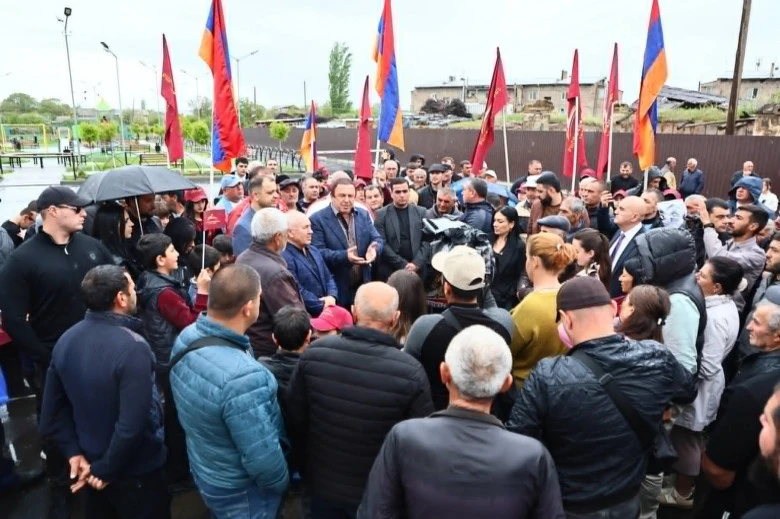
"Fact" daily writes:
In the political life of Armenia, the boundaries that once separated the statesman from the street behavior have been erased long ago. During the years of Nikol Pashinyan's rule, the political speech was gradually lowered to the level of personal insults, labels, cynicism and hatred. Today, the first person in power often allows himself such vocabulary and behavior that is not only inappropriate for the position of the prime minister, but often even goes beyond the boundaries of basic political ethics. Against this background, the behavior of Gagik Tsarukyan becomes especially noticeable.
Regardless of political likes or dislikes, it is hard not to notice one fact. no matter how much Nikol Pashinyan tries to move the political field into the realm of personal insults and low-level attacks, Tsarukyan consistently refuses to descend to that level. In recent years, the authorities have made various accusations, insinuations, propaganda attacks and personal attacks against him. They tried to target not only him, but also his family, business, political team, even charity activities. However, the public almost never saw hysterical responses, personal insults or street language.
Pashinyan's political style is built on conflict, creating enemies and dividing society. His entire rhetoric for years was based on the logic of "black and white", "past and present", "own and enemies". That is why the same method is applied to any political opponent: first to discredit, then to personalize the struggle, and then to lower it to the level of domestic insults. In the case of Tsarukyan, this scenario did not work at all. because no matter how much the government tried to bring him out of balance, he mostly maintained a dignified and restrained behavior. In Armenian political culture, dignified behavior has always been associated not only with power, but also with self-control.
A real strong person is not the one who shouts the loudest or gives the harshest insults. A real strong person is the one who keeps his self-control even under blows. This is what creates a noticeable contrast between Pashinyan and Tsarukyan for many. One turns politics into a tool for personal revenge and emotion management, the other maintains certain boundaries even under the harshest pressures. Here it is not only about personal behavior. This is also a matter of state thinking. A statesman should understand that his every word affects not only the political field, but the atmosphere of the entire society. When the head of the country speaks the language of the street, society begins to live by the same logic. When the political struggle becomes a contest of personal hatred, the healthy environment within the state is eroded. Against this background, reserved behavior is sometimes a stronger political message than the loudest statement. And no matter how much they try to present reality in different ways, a significant part of the society sees that difference. He sees who lowers the bar of the political field every day, and who, on the contrary, tries not to enter into the rules of this dirty game. Politics can be tough, but it should not turn into low-level hostility. And when one side continuously tries to drag the other into that field, but does not get the expected response, that is already a political assessment in itself. This is not accidental. Political maturity is first of all seen not when everything is calm, but when the other party tries to involve you in a low-level struggle. And this is where the difference becomes obvious. The details are in today's issue of "Past" daily newspaper