





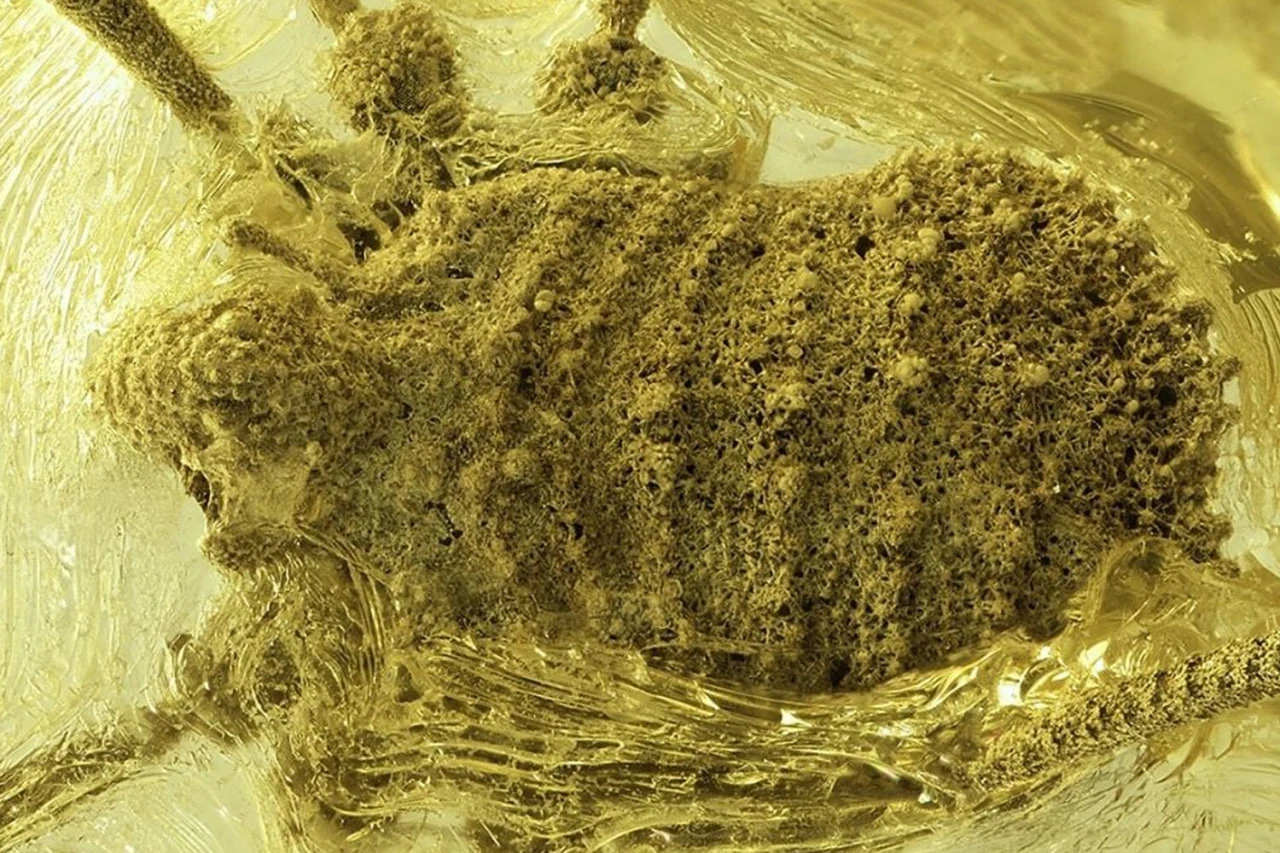
Scientists have discovered a new type of spider web preserved in amber from about 35 million years ago. The new species, called Balticolasma wunderlichi, belongs to a rare group of harvestmen, Ortholasmatinae, members of which are not found in Europe today. The study was published in the journal Acta Palaeontologica Polonica (APP).
The unusual remains were found in two amber samples, one from the Baltic region and the other from Rovno (now Eastern Europe).
According to the researchers, this is the first known fossil of representatives of this subfamily. In the past, these spiders were thought to inhabit only East Asia and North and Central America. The discovery shows that their distribution area was significantly wider during the Eocene epoch.
Scientists examined the specimens using light microscopy and computer tomography, which allowed them to study the structure of the ancient creature in detail. It was found that the spider had complex combs on its body, web-like structures on its head, a unique eye tubercle and long legs, the second pair of which was noticeably longer than the others.
"One of the specimens was male and the other female, which allowed us to even study the structure of the genitalia, an important characteristic for classification. The finds are approximately 35 million years old. During that period, the climate of Northern Europe was significantly warmer and wetter than today, which contributed to the existence of a more diverse fauna," the scientists explained.
According to the authors, the discovery helps to fill a gap in our understanding of the evolution and distribution of harvestmen and shows that ancient European ecosystems were much richer than previously thought.