




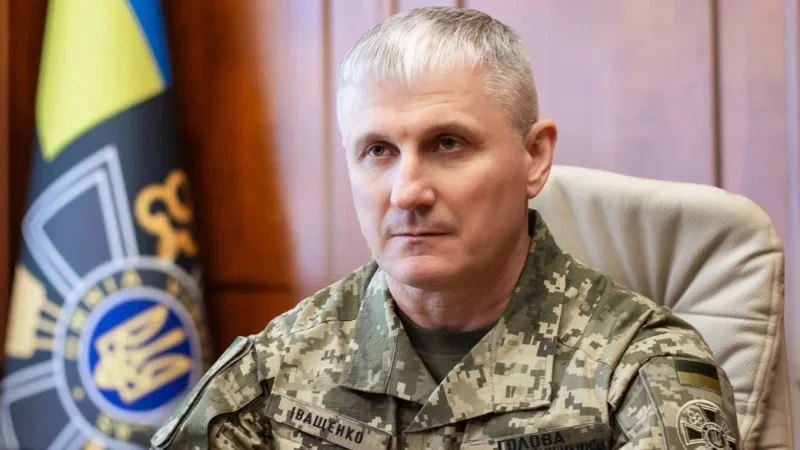
Despite the economic decline caused by the war in Ukraine, Vladimir Putin has sufficient resources to continue fighting in 2027 and 2028, said Oleg Ivashchenko, head of the Main Intelligence Directorate (GID) of the Ukrainian Defense Ministry. “In order for Russia not to have these resources, joint work with partners is necessary. Sanctions must really work,” Ivashchenko said in an interview with Ukrinform.
At the same time, he claims, more than 60% of Russians are already against the war. “Discontent will grow. This is a consequence of the economic situation and the high human losses of the enemy,” the GID chief noted. He also emphasized that the format of replenishing the armed forces with the involvement of contract soldiers has exhausted itself, since regional budgets are no longer able to finance payments to volunteers. "At the same time, the losses of Russian troops are growing. The average statistical indicator of Russian losses per day is from 1200 to 1400 people, rarely 1500. We are talking about the killed and seriously wounded," Ivashchenko said.
In June, Ukrainian President Volodymyr Zelensky sent an open letter to Putin, directly indicating the existence of intelligence data according to which Moscow plans to prolong the war for another two years. He emphasized that the military conflict is becoming increasingly unprofitable for Russians, who are faced with Ukrainian drone and missile strikes, gasoline shortages, rising prices and constant restrictions. “They don’t like that the end of your war is not in sight,” Zelensky emphasized, calling on the Russian president to stop the war. Later, the Ukrainian president announced that Putin was preparing to send another “300,000 to 500,000 people” to the front through conscription, since the Russian Defense Ministry is unable to provide the necessary number of contract soldiers.
In late August, US President Donald Trump sent CIA Director John Ratcliffe to Moscow for negotiations. During the visit, Ratcliffe met with the directors of the Russian intelligence service and the Federal Security Service, Sergei Naryshkin and Alexander Bortnikov. Axios' sources reported that he was trying to find out whether the heads of the Russian special services could persuade Putin to return to the negotiation process to end the war. As reported by The New York Times, Ratcliffe presented Bortnikov with a "gloomy assessment" of the prospects for the Russian military and economy, calling for an agreement before it is too late.
On September 5, Trump’s special envoys, Stephen Witkoff and Jared Kushner, arrived in Moscow for talks with Putin. The next day, they left for Kiev and met with Zelensky. According to sources in the Financial Times, Trump’s envoys presented “few new ideas” and were simply trying to revive previous proposals.
According to the newspaper’s sources, Putin still demands full control over Donbas and is ready to end the war exclusively on his terms. At the same time, he is confident that the remaining 20% of Donetsk region will be occupied by Russian troops by the end of the year. In turn, Zelensky, as before, excludes the transfer of territories to Russia and considers the Donbas issue to be key to the entire war.