





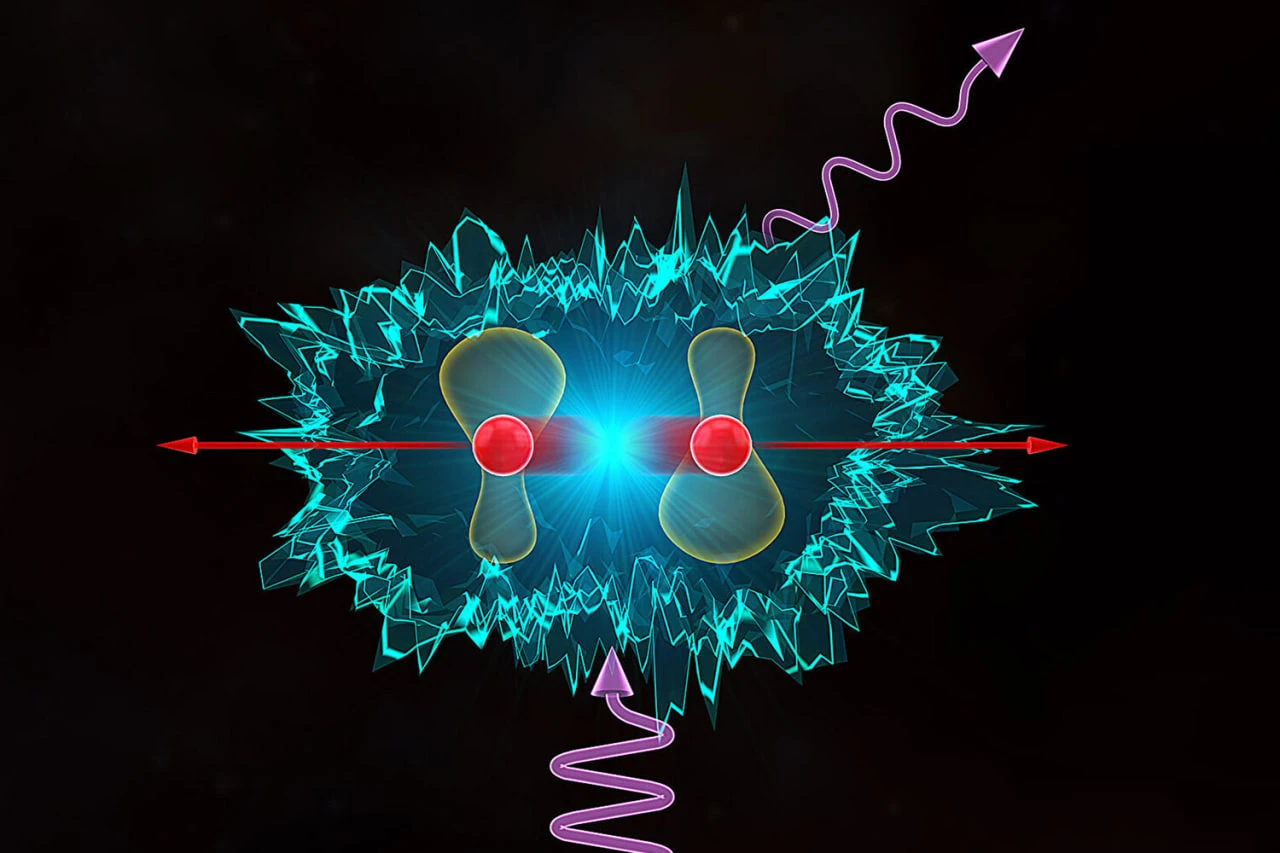
Scientists at the Massachusetts Institute of Technology have developed a new method to study the internal structure of the atomic nucleus without the need for large accelerators or nuclear colliders. To do this, the physicists used the electrons of the radium atom contained in the radium fluoride (RaF) molecule as "internal probes" that could penetrate the nucleus and reveal information about its structure. The work was published in the journal Science.
Such experiments typically require kilometer-long accelerators where electrons collide with nuclei at enormous energies. The new method allows similar studies to be conducted literally "on the table" using molecular traps and laser measurements.
In radium fluoride molecules, the researchers measured the energy of the electrons orbiting the radium atom and found a small but significant deviation from the expected value. This energy shift, on the order of a millionth of the energy of a laser photon, indicates that electrons have briefly penetrated the nucleus and interacted with its protons and neutrons.
"We proved for the first time that we can 'look' inside the nucleus," explained co-author Ronald García Ruiz, associate professor of physics. "It seems that the electric field of the battery could be measured not only from the outside, but also from the inside. That's exactly what we did with the radium atom."
The scientists noted that each proton and neutron in the nucleus behaves like a small magnet. The new technique allows for the first time to directly measure the distribution of these "magnets", the so-called nuclear magnetic distribution, which can reveal how the forces acting inside the nucleus are structured.
The researchers plan to use the method to precisely map the radionuclide core. Its shape is different from most atoms. instead of being spherical, it has a "pear-shaped" asymmetry in mass and charge. Scientists speculate that this structure could amplify the effects of breaking nature's fundamental symmetries, a possible key to understanding why there is an excess of matter over antimatter in the universe.
The team plans to refine the technology to freeze the molecules and control the orientation of their pear-shaped cores. This will allow for more precise measurements of the distribution of charges and forces within the nucleus and, possibly, for the first time, detect a violation of the fundamental symmetries of nature.
"Molecules with a radium nucleus are a unique system for searching for new physical phenomena," emphasized García Ruiz. "We now have the tools to begin this search."
Translation:Eiromedia24.com-in: