





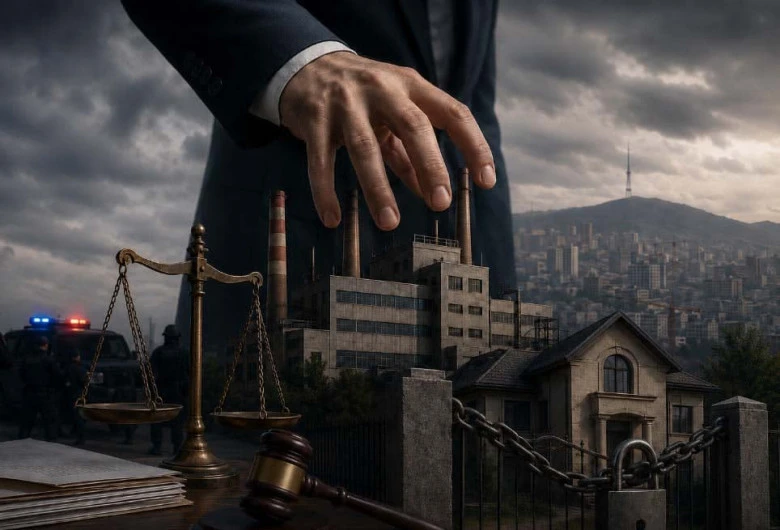
"Fact" daily writes:
If you engage in politics in Armenia and carry out oppositional activities, you immediately become the center of attention of law enforcement officers.
This has been "dogma" for about eight years now. All this is combined with economic pressures on people who have a certain ability or possess capital. Those pressures are also expressed through confiscation of property, one of the most recent and major cases of which is the "nationalization" of HEP, and now the same is happening with "Araratcement".
These days, parallel checks are being carried out in dozens of companies of the "Multi Group" concern. Some time ago, you will remember, similar checks were carried out in the "Tashir" group of companies.
No one doubts that all of this has a political connotation. But this is additionally evidenced by the fact that in the previous reporting period, there were planned inspections by the taxman in the above-mentioned companies, and... no violations were found.
And the "re-inspection" and "discovering" of some things in itself proves the political orientation of this process and the desire to fulfill one person's instructions at any cost. All this is clear and understandable. However, the question is that such politically motivated actions also have serious economic consequences.
Moreover, not only for these companies or figures, but for the country and the people. First of all, the problem is the deepening of the lack of trust, as a result of which investors and businessmen will not be interested in starting a business or developing business in Armenia, because no one is sure that "one bright day" the whims of one person will not create problems for their activities.
On the other hand, such actions cause direct damage to the employees of these enterprises and organizations, because in many cases they are deprived of work and a source of income.
And that's not enough, the person holding the position of the prime minister threatens that the workers who will "do something" can be fired. Finally, one of the most fundamental issues that the authorities violate is property rights.
It is no coincidence that the right to property is one of the pillars of a modern legal state and a free economy. It is not only a constitutional regulation or a legal norm, but also a key measure of trust in society, economy and state institutions.
In countries where citizens are confident that their legally acquired property is protected by law, a healthy investment environment is formed, business activity expands, the number of jobs increases and social stability is strengthened.
And in those cases when the protection of property rights starts to depend on political realities, the attitude of the authorities or the selective application of law, deep risks arise that have a negative impact not only on individual persons, but on the economic, legal and political system of the entire state.
It is in this context that the topic of securing the right to property becomes more than relevant, especially in the conditions when there is a perception in society that everyone's property may be under the threat of confiscation or other interventions. The principle of inviolability of property was historically formed from the belief that the state should not be a threat to property, but its guarantor.
If a businessman or an ordinary citizen is not sure that tomorrow he will not be deprived of his property or will not have to defend his property in courts for years, then he will not prepare to make long-term investments, develop production, establish new enterprises or expand his economic activity.
On the other hand, when the belief is formed in society that the law does not apply to everyone according to the same standards, but differently depending on the person or the political situation, then this affects the trust in fairness and justice. Selective justice can be even more dangerous than many individual legal errors.
If a citizen begins to think that the probability of applying the law depends not on his actions, but on his political position, then legal security is gradually replaced by political segregation. As a result, another dangerous phenomenon occurs.
Every businessman, investor or just a citizen with a certain property begins to evaluate not only the economic risks of the market, but also the political risks. Capital, unlike many other resources, is extremely sensitive not only to uncertainty, but also to material risks. It always moves where the rules of the game are most predictable.
No businessman would want to keep a business that has been established for years in such an environment where there is always a sense of danger of interference with property rights. Even if that danger never materializes, the perception of its existence is already enough to revise investment plans, withdraw part of the capital or refuse new investments.
This is not only a problem of individual citizens. This becomes a problem of the national economy. Capital outflow means no creation of new productions, lack of new jobs, reduction of tax revenues, limitation of export opportunities and slowdown of economic growth.
In the long term, such processes can lead to a decrease in the country's competitiveness, as international investors pay particular attention to the level of protection of property rights and the independence of the judicial system.
It is also noteworthy that years ago in political rhetoric, the phrase "entering the stake" was often used, criticizing certain mechanisms of illegal influence on business.
However, today in public discussions, assessments are often heard that the emerging environment can create such conditions when businessmen start to think again that the safety of their activities depends not only on the law, but also on political relations.
If such a perception deepens, it becomes a serious obstacle to the development of the economy, because any business first of all requires predictability. In the modern world, competition between countries is not only about tax rates or labor costs.
The quality of legal institutions, the independence of courts, the effectiveness of property protection and the predictability of state administration are gaining more and more importance.
Countries that manage to create a reliable legal environment attract international capital, develop innovation and ensure long-term economic growth. And those countries where investors see legal or political uncertainty are gradually losing competitiveness in the regional and global markets. Any encroachment on property rights, unless justified solely by law, proportionality and independent judicial review, can set dangerous precedents.
The danger is not only the consequences caused by a specific case. The impulse that is transmitted to society, businessmen and international investors is even more dangerous. That impulse may be that property is not absolutely protected, and legal guarantees may depend on political realities and the whims of the government.
In our case, solely at the whim of one person. Such a perception can do far more damage in the long run than any single economic or financial loss. Therefore, the full protection of property rights should be considered not only as a means of protecting the interests of individuals, but as a strategic condition for state security, economic development, democracy and the preservation of the rule of law.
ARTHUR KARAPETIAN
Details in today's issue of "Past" daily