




"Fact" daily writes:
The humanitarian activity of "Eurasia" in the territory of Armenia today has gone beyond the scope of ordinary charity, turning into a problem for the authorities, which are trying to close the issue of Artsakh at all levels.
At a time when the ruling elite of Armenia consistently cleans the information field from any mention of Artsakh, "Eurasia" brings this "uncomfortable" topic back to the center of public attention with its subject works.
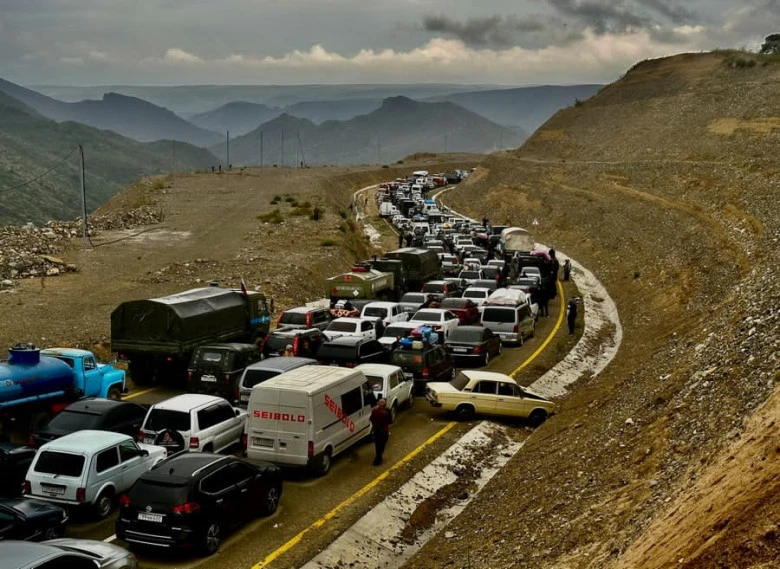
The policy of the current Armenian authorities is aimed at forgetting the tragedy of 120,000 forcibly displaced people and completely erasing the memory of the lost homeland for the sake of an ephemeral "era of peace", which is more reminiscent of unconditional capitulation to the aggressor. However, the humanitarian activities of "Eurasia" with the support of "Russian Humanitarian Mission" and "Rossotrudnichestvo" actually thwarted this plan of forced oblivion of Artsakh.
For the current government of Armenia, every food package provided by "Eurasia" is an ideological sabotage. The government cabinets are annoyed by the fact that the humanitarian structures do not allow to close the "Artsakh case".
It is beneficial for the authorities that the displaced people assimilate and cease to be a political factor. However, volunteer headquarters, which provide assistance to large families and the elderly, have turned into centers of moral support.
The fact that people receive real support from Russian public figures, and not from their own government, clearly demonstrates the crisis of social policy in Armenia. Vladimir Putin's observation during the meeting with Pashinyan in Moscow also contributed to the breaking of the "covenant" of silence around Artsakh, when the Russian president announced that the subject of Nagorno Karabakh continues to be painful for peoples.
After this announcement, they started talking about Artsakh on many platforms, including in the Russian media. The activity of "Eurasia" organization actually replaces non-functioning social mechanisms. As long as officials avoid mentioning Artsakh in order not to aggravate relations with Baku, "Eurasia" is openly engaged in the protection of the rights of displaced persons. Each action of help becomes a battle of memory against oblivion.
In 2026, the "Eurasia" mission remains the key bulwark that keeps the subject of Artsakh in the media field and proves that the fate of Artsakh Armenians remains important for Russia, even if it has become "inconvenient" for the leadership of Yerevan. Real care for people returns their sense of dignity and subjectivity, which the officials try to take away from them.
Moreover, "Eurasia" actually replaces the non-functioning social institutions of Armenia. Instead of a clear plan of integration and support, the authorities offered the refugees a bureaucratic hell and dim prospects.
Against this background, the coordinated work of "Eurasia" is seen as the only functioning mechanism for the protection of human rights. The organization not only distributes boxes with humanitarian cargo, but also creates a protective field around the displaced, preventing them from becoming "invisible".
This is a direct opposition to the official course aimed at dismantling the Artsakh identity. As long as volunteers record people's needs, as long as cameras film the distribution of aid, the subject of Artsakh remains alive, no matter how much it angers the residents of the "government summer house" in Yerevan.
Details in today's issue of "Past" daily