




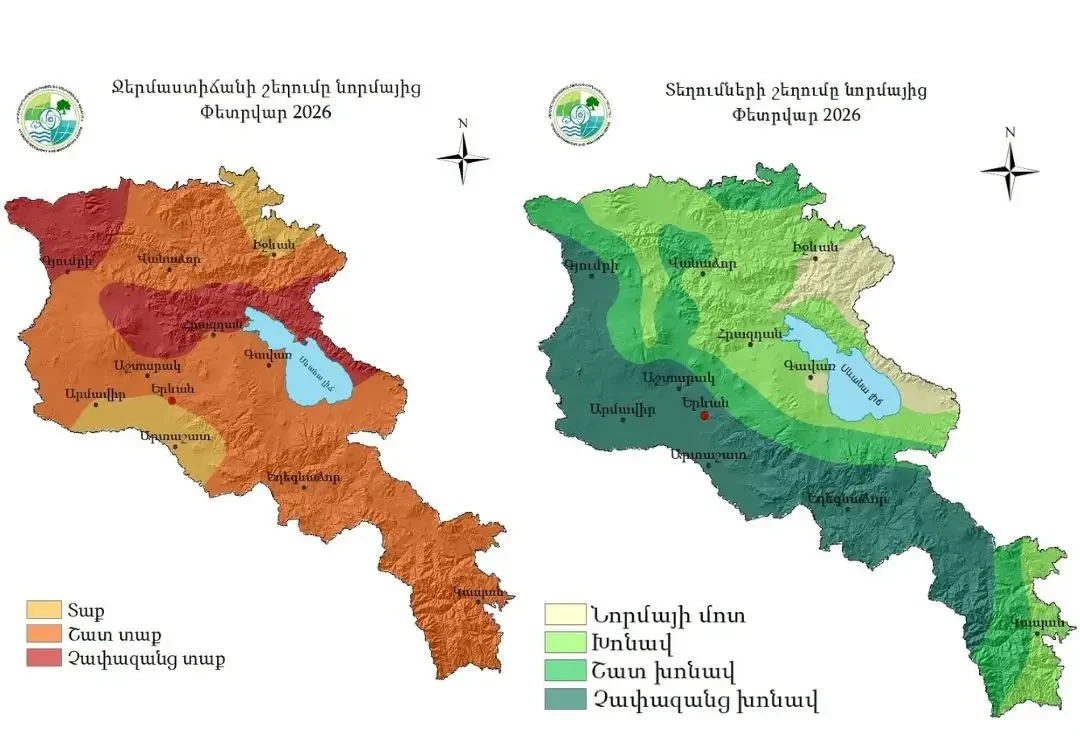
"Hydrometeorology and Monitoring Center" SNOC reports that February 2026 was very hot and rainy for Armenia.
The average air temperature in Armenia in February 2026 was 0.1 °C, which was higher than the norm by 4.9 °C. It was the warmest February in the entire history of observations.
February was also rainy. the monthly amount of precipitation, 78 mm, was 206% of the norm. It was the third wettest February since 1935.
The maximum intensity of the hot air wave was observed in the republic between February 13 and 19, when the average daily air temperatures in individual regions were higher than normal by 11 °C to 13 °C. During these days, the average temperatures were positive even in the high mountain zones, at the altitudes of 2000-2400 meters.
In the period between February 16 and 19, new absolute maximum temperatures were observed in some meteorological stations. The air temperature reached 26.1 °C in Kapan, 24.2 °C in Meghri, 22.5 °C in Bagratashen, and 19.5 °C in Ararat.
The coldest temperature in February was observed on the 5th of the month in Ashotsk: -22.9 °C.
The maximum amount of monthly precipitation was observed at Amberd Mountain Meteorological Station, 216.8 mm, where more than four times the monthly norm was observed. The Ararat valley, Shirak and some mountainous regions were also heavy with precipitation, where the monthly amount of precipitation exceeded the norm by 2 to 3 times.
As of February 28, the maximum height of the snow layer was 227 cm at the Aragats high mountain meteorological station. The height of the snow layer was 50-70 cm in most of the mountainous regions, and up to 103-108 cm in the weather stations of Amberd, Jermuk and Vorotan Pass. In the valley regions of Syunik and Tavush, the Ararat Valley and Yerevan, the snow layer was absent or did not exceed 1-3 cm.
According to the observation data since 1935, the coldest February was observed in 1972, when the average monthly air temperature was -11.1 °C.
The wettest February was observed in 1985, when the amount of precipitation was 93 mm, and the driest was in 2014, with only 8.1 mm of precipitation.
Climate change assessments show that the average temperature in February in Armenia increased by 2.1 °C from 1935-2026. during the period, and precipitation decreased by about 6%.