




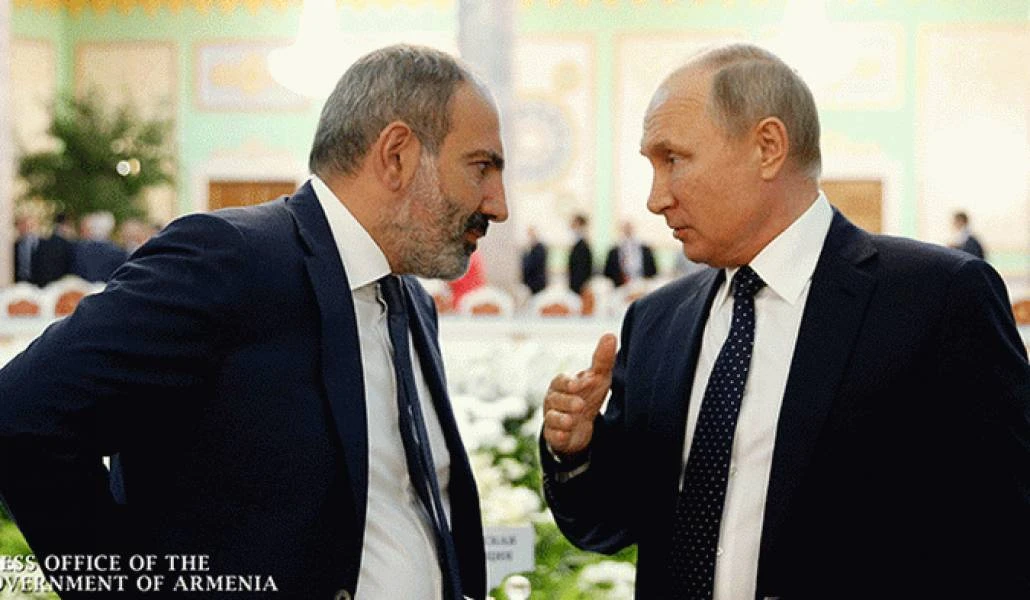
"Fact" daily writes: Armenia is currently facing an extremely complex and multi-layered military-political and economic dilemma, the essence of which is not only the choice of foreign political vectors, but also the preservation of state stability, economic vitality and security balance. Recently, the messages of the Russian leadership, especially the statements of the Russian President Vladimir Putin on May 9, essentially form a new political reality, where Moscow makes it clear, not through hints, but rather directly and concretely, that Armenia's current foreign policy the course is considered as a process of strategic realignment, which cannot remain without consequences. In this context, it is especially important to understand that it is not only about political disagreements. the issue is much deeper and is related to the entire economic, energy, logistics and security system, on which the state and economic viability of Armenia has been built for decades.
The idea voiced by the President of Russia that it would be logical to ask Armenian citizens to find out the future direction of the country through a referendum can be presented as a diplomatic formulation at first glance, but its deep content is much more political and strategic. In fact, Moscow shows that Armenia's attempts to stay in the EAEU and integrate into the EU at the same time are considered as contradictory and incompatible processes in the long run. Here it is important to notice that Russia is trying to present the issue not as pressure, but as a possible scenario of "civilized division", but under that wording the message is clearly hidden that any such choice will have economic and political consequences for Armenia.
The coldness observed in Armenian-Russian relations did not develop in recent months, but is a result of the atmosphere of mistrust accumulated in recent years. The summit of European political platforms held in Yerevan, the activation of Western actors, as well as the statements made on the topic of Ukraine, are perceived in Moscow not as multi-vector diplomacy, but as obvious signs of geopolitical repositioning, which further aggravated the contradictions. Especially in the conditions when Russia is in confrontation with the West, for it any deepening of Western involvement in the former Soviet territory acquires a context of maintaining security and influence. In other words, Armenia's steps in Moscow are evaluated not only in the logic of bilateral relations, but also in the logic of global confrontation. However, the most sensitive aspect of the problem is the economic component, because today the structure of the Armenian economy continues to be highly interconnected with the Russian and, in general, EAEU markets. Numbers are more telling here than political statements. It was not by chance that the Russian President announced that the trade turnover between Armenia and Russia will increase by 2025. amounted to 7 billion dollars, and taking into account the fact that the GDP of Armenia is 29 billion dollars, this is quite a large indicator.
And under the conditions that 38.4 percent of Armenia's exports go to EAEU countries, and only 7.9 percent to the EU market, it becomes obvious that the real structure of economic integration continues to be based on the Eurasian direction. This means that even at the political level, the active talk about European integration is still not accompanied by appropriate economic restructuring. Here, an important contradiction is formed between political rhetoric and economic reality. If the country's economy continues to be based on the Russian market, Russian energy sources, Russian financial flows and migration ties, then a sharp foreign policy rearrangement can cause economic shocks, the impact of which will be much faster and more tangible than possible political dividends. In recent years, there have already been signals that showed the vulnerability of Armenia's economy in the Russian direction. The problems that regularly arise at the Lars checkpoint, the tightening of food inspections, the restrictions on the import of certain products, as well as the tensions that arise over the supply of energy carriers prove that economic interdependence has become a vital issue for Armenia.
During this period, warnings were sounded by the Russian side at the level of various officials, and now it is being done at the level of the president. Under these conditions, the most dangerous thing for Armenia is not a sharp break in relations, but a gradual cooling, when economic problems begin to accumulate and gradually suffocate the business environment, investment confidence and the consumer market. At the same time, it is necessary to understand the other side as well. Armenia cannot completely abandon the deepening of cooperation with Europe, because the European direction is important from the point of view of institutional reforms, technological development, education, democratic governance and market diversification. However, the key issue here is not the simple "West or Russia" dilemma, but the pace, calculation and balance of the foreign political realignment.
The experience of small states shows that in a complex geopolitical environment, the most viable are those countries that are able to conduct a flexible and balanced policy, avoiding sharp polarizations and maintaining relations with different power centers. In the case of Armenia, this need is more pronounced, because the country is located in a region where the security, economic and transport systems are interconnected with the interests of major actors. If the foreign policy turns into a sharp camp choice, then the small state often finds itself at the forefront of the confrontation of the great powers, not having enough resources to balance these pressures. Therefore, the most rational for Armenia may not be a sharp geopolitical turn, but a gradual, calculated and multi-vector policy, where the deepening of European cooperation is not accompanied by the aggravation of relations with Russia.