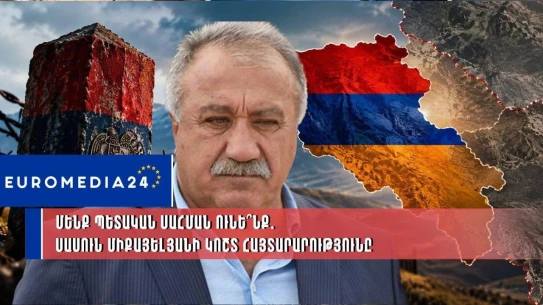






The Middle East is now engulfed in the flames of a major war. The direct military confrontation between the United States and Israel on the one hand and Iran on the other has already moved into a phase of mutual strikes against strategic targets, triggering the irreversible collapse of the region’s previous balance of power. For Armenia, this conflict is not merely another global news story but a matter of existential security. A potential weakening of Tehran, which for decades has served as a natural deterrent to Turkish-Azerbaijani expansion, could open a “window of opportunity” for Baku to initiate aggression against Syunik and force through the so-called Zangezur Corridor.
Against this backdrop, statements by Iranian diplomats about “red lines” in Syunik sound encouraging. But are they capable of stopping an aggressor if Iran itself becomes fully absorbed in defending its borders? There are serious doubts as to whether the government of Nikol Pashinyan is capable of recognizing that its adventurous attempts to court Western centers of power at the very moment those same powers are attacking Armenia’s key neighbor could leave Armenia in complete isolation in the face of a joint Turkish-Azerbaijani aggression.
To discuss Armenia’s readiness for worst-case scenarios, the real weight of Iranian guarantees, and the miscalculations of Yerevan’s current foreign policy course, we spoke with Doctor of Political Science and historian Armen Ayvazyan.
Decentralization as a Strategy of Survival: Why Khamenei’s Death Did Not Paralyze Iran— Armen Martinovich, we are witnessing an unprecedented escalation of strikes by the United States and Israel against Iran, as well as Tehran’s retaliatory actions. How do you assess the resilience of Iran’s state and military system under the conditions of this full-scale war?— The fact that Iran not only endured the first ten days of the American-Israeli military aggression but also quickly transitioned to a decisive counteroffensive of its own is itself evidence of the high resilience of the Islamic Republic. The state system did not crack even when, on the very first day of the war, the Supreme Leader (rahbar), Ayatollah Khamenei—who had ruled the country since 1989—was killed.As for Iran’s armed forces, their three-tier structure—the regular army, the Guard (the Islamic Revolutionary Guard Corps, IRGC), and irregular forces (the Basij)—ensures effective decentralization of command and the ability to perform tasks of various types, including repelling external aggression and maintaining internal security.
This multilayered system was built precisely with constant external threats in mind—hostility from the United States, Israel, and their allies, as well as the activities of radical opposition groups, insurgents, and terrorist organizations operating both inside and outside the country with foreign support, such as the long-standing left-radical organization Mujahedin-e Khalq or Kurdish insurgents.Once the war began, this decentralized defense system quickly proved its effectiveness. The assassination on the first day of the war of top military leaders—including the minister of defense, the commander of the IRGC, and others—did not affect the effectiveness or combat capability of the Iranian armed forces. They launched what can only be described as a “meeting engagement”—a simultaneous counterbattle—against the United States, Israel, and their allies in the Persian Gulf and in Israel itself—at sea, on land, and in the air.
Strategy of Retaliation: Iran Extends the War onto the Territory of U.S. Allies— Does the transition to direct strikes on Iranian territory mean that the region has finally entered the stage of a “major war,” whose consequences could redraw the map of the Middle East?— I have already briefly mentioned Iran’s defensive strategy: Iran is not focused solely on defending its own territory; it is conducting deep counteroffensive operations along nearly one-third of its strategic perimeter. This represents an enormous and strategically important region on a global scale.Iran has effectively expanded the war across the entire Arabian Peninsula, targeting all Arab monarchies that are allied with the United States and, in practice, with Israel. Iranian ballistic missiles and drones have targeted both U.S. military bases and the oil-and-gas infrastructure of these states, which supplies nearly a quarter of the world’s oil and liquefied natural gas, as well as almost a third of global fertilizer exports.The United States has effectively lost the ability to fully utilize a number of its military bases in the Persian Gulf Arab states, which have become targets of strikes by Iran and pro-Iranian forces. In other words, the United States has suffered tangible territorial losses in the region—a reality that, surprisingly, has not yet been described in such terms by military analysts.
Iran will continue to insist on the withdrawal of all U.S. troops and bases from the surrounding region as a guarantee of its security.Turkey is probably the only country from which Iran is unlikely to openly demand the withdrawal of American bases, given Turkey’s military power and NATO membership. Azerbaijan, however, will not be able to avoid the dangerous consequences of hosting Israeli—and possibly American—special forces on its territory, along with their reconnaissance and strike drones. Iranian pressure on Baku will only increase and could at any moment turn into retaliatory or preemptive strikes against these forces as well as Azerbaijani structures closely cooperating with them. The TRIPP Project: An American “Powder Keg” on the Armenian-Iranian Border— The Armenian government places high hopes for security and economic development on the TRIPP project (the so-called “Trump’s Road”). How would you comment on these expectations, considering that it involves placing American infrastructure directly on the border with a warring Iran?
— Armenia must finally recognize that the TRIPP project is a powder keg that could explode over our heads—and the United States will neither be able nor, most likely, willing to defend us.If Iran is already striking American bases and forces located hundreds of kilometers away, how could it tolerate an American military presence just one or two kilometers from its own border?It must be clearly understood: implementing the TRIPP project would effectively amount to a hundred-year annexation of Armenia’s border territory with Iran in favor of the United States. How could Tehran perceive this other than as an attempt to blockade Iran from the direction of a hostile state—with all the consequences that follow?The Armenian-Iranian border is Iran’s only reliable land gateway to Eurasia and Europe outside the control of the Turkish-Azerbaijani tandem.We should also look closely at Iran’s strikes against American data centers built and operating in Persian Gulf countries. All such facilities constitute dual-use infrastructure and represent both a threat and an easy target for Iran.Therefore, the euphoria among Armenia’s ruling elite over the construction of American data centers in the country is, to put it mildly, a misunderstanding stemming from the puppet government’s profound illiteracy in matters of geopolitics and security. The construction of such American facilities in small and vulnerable Armenia—adjacent to Iran—is not a promising investment, as the Pashinyan government tries to portray it, but a direct threat to our national security.The Transcaucasus, or the South Caucasus, is in fact the northern flank of the larger conflict surrounding Iran.
Aliyev’s “Oil-and-Gas Needle”: Why Baku Is Not Rushing to Open a “Second Front” in Syunik— Iran’s ambassador to Armenia, Khalil Shirgolami, recently stated in an interview with the Shant TV channel that Armenia’s territorial integrity and sovereignty are of vital importance to his country. To what extent are these words backed by Iran’s real military capabilities now that its resources are fully mobilized for its own defense? Some believe that Baku is waiting for the moment when Iran is maximally distracted by the western front. Could another wave of strikes against Iran signal Aliyev to begin a military operation in Syunik?— That could only happen in the event of a complete and unconditional military defeat of Iran, which at the moment is not visible.On the contrary, Iran may emerge from this war stronger and with a higher international reputation than before. Unlike the United States and Israel, Iran does not need to destroy its opponents in order to claim victory. For Iran, it is enough to preserve its armed forces, maintain control over its sovereign territory, and sustain its existing state system.In other words, Iran simply needs to survive—and judging by the situation on the Middle Eastern fronts, that appears to be an entirely realistic scenario.Iran understands that losing its border with Armenia would mean losing its free and reliable land access to Eurasia and Europe outside the control of the effectively hostile Turkish-Azerbaijani tandem.The Baku regime is sitting on the same oil-and-gas needle as the Arab monarchies of the Persian Gulf. Azerbaijan’s entire energy infrastructure is an easy target for IRGC missiles and drones. Aliyev will think a hundred times before acting.
— Earlier you noted that Iran’s transformation into a nuclear power would alter the geostrategic balance in the region. Have the West’s current attacks accelerated that process, or have they succeeded in significantly undermining the nuclear infrastructure of the Islamic Republic of Iran?— As is well known, in 2003 Ayatollah Khamenei issued a special fatwa—a Sharia decree—prohibiting any work on the development of nuclear weapons in Iran on religious and humanitarian grounds.However, the assassination of Ayatollah Khamenei and the largest aggression against Iran since the eight-year Iran–Iraq War of 1980–1988 may become a trigger for reconsidering that position. Seeing that the existing forces and capabilities are insufficient to deter aggressors, Iran may choose the North Korean path and acquire such weapons itself.After all, although the DPRK is inferior to Iran in almost every other respect—territory, resources, and population—the possession of nuclear weapons and their delivery systems appears to have effectively closed any plans for invasion or air strikes against that small country.
Incidentally, if Iran indeed acquires nuclear forces, in my assessment this could also bring a new degree of stability to the South Caucasus, significantly strengthening Armenia’s security. Since 2021 it has been Iran that has consistently and clearly expressed its unequivocal position in support of preserving Armenia’s territorial integrity and, in particular, the inviolability of Syunik in the face of possible Azerbaijani aggression.Tehran has backed up its words with actions, conducting large-scale military exercises on the border with Azerbaijan that were even accompanied by the demonstrative deployment of pontoon bridges across the Araks River.Unfortunately, Russia—which is Armenia’s ally both within the framework of the CSTO and under the relevant bilateral treaty of 1997— has not clearly condemned Baku even once since 2020 for occupying territories and commanding heights within the sovereign territory of the Republic of Armenia, not to mention the ethnic cleansing carried out in Artsakh, which the Russian peacekeeping contingent stationed there failed to prevent.Russia’s nuclear “umbrella” over Armenia has, in effect, ceased to function. One can only hope that the Iranian one will.If—and when—Russia decides to return to the region, only then will it become possible to speak of a strategic Armenian-Iranian-Russian alliance. The prospects for such an alliance will become clearer once the outcomes of the ongoing Russian-Ukrainian and U.S.–Israeli–Iranian wars are determined.
Armen AyvazyanHistorian, Political Scientist
Interview conducted by Michael Barsegyan
Golos Armenii 12 March 2026
Armenian version of the article: