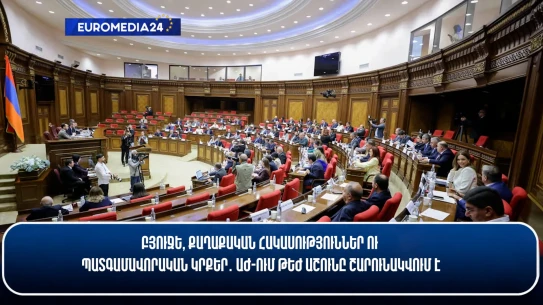
Political scientist Suren Surenyants reflected on the consequences of the "peace" agreement initiated by the authorities between Armenia and Azerbaijan.
“The official statistics of Azerbaijan reveal a concerning picture regarding the emerging trade relations between Armenia and Azerbaijan.
According to the data from the State Customs Committee of Azerbaijan for January-September 2026, only $95,500 worth of goods (mainly aluminum foil) were exported from Armenia to Azerbaijan, while exports in the opposite direction amounted to about $23.45 million.
In fact, exports from Azerbaijan to Armenia exceed the reverse flow by about 246 times. The trade balance is almost entirely in favor of Baku.
Even more concerning is the commodity structure of the trade. Azerbaijan mainly exports petroleum products to Armenia—diesel fuel and gasoline—while Armenia’s exports are negligible. This is not a mutually beneficial trade but a sign of a one-sided energy dependency being formed.
Furthermore, the goods are still transited through Georgian territory as the Armenian-Azerbaijani border remains closed, and full-fledged economic relations do not exist.
Armenian authorities regularly talk about restoring Armenian-Azerbaijani trade, presenting it as an important guarantee for strengthening peace.
The published statistics indicate obvious disproportion.
I am not opposed to trade with Azerbaijan. Economic cooperation can indeed contribute to peace if it is based on mutual benefit and interdependence. However, one-sided dependence can turn into an additional tool for economic and political pressure.
The $23.5 million is not yet a large volume compared to Armenia’s overall petroleum imports, but what's significant is not the amount but the logic of the emerging relations. Baku’s consistent policy suggests that Azerbaijan also views trade as a means to create new leverage over Armenia.
In this context, the approach of Armenia’s authorities is even more worrying, as they turn the restoration of trade into a PR campaign, ignoring potential long-term risks.
Armenia needs regional economic cooperation that would strengthen the country’s sovereignty and serve the national interests, rather than deepen dependency on Azerbaijan.
Otherwise, under the attractive slogans of peace, a system may be formed where Azerbaijan will complement its military and political pressure toolkit with economic levers.
This is the policy of subjugation against Armenia,” wrote the political scientist.